

Osteoporosis is a skeletal disease characterized by loss of bone mass, reduced bone strength and increased bone fragility predisposing to fractures. Bone health is affected by many factors, but osteoporosis is viewed as a calcium deficiency disorder in which bone is resorbed to maintain serum calcium levels when calcium excretion is not balanced by calcium absorption. Osteoporosis is a major global public health concern affecting nearly 500 million people worldwide, particularly older adults and postmenopausal women. According to the International Osteoporosis Foundation, approximately 200 million women are living with osteoporosis globally, and nearly one in three women and one in five men above the age of 50 are expected to suffer an osteoporotic fracture during their lifetime. The disease is responsible for more than 8.9 million fractures every year, meaning an osteoporosis-related fracture occurs approximately every three seconds worldwide. Globally, osteoporosis and low bone mineral density contribute significantly to disability, reduced quality of life, and increased mortality among the elderly population. With increasing life expectancy and ageing populations, especially in Asia, it is estimated that by 2050 more than 50% of all osteoporotic fractures will occur in Asian countries.
In India, osteoporosis has emerged as a rapidly growing health challenge due to nutritional deficiencies, sedentary lifestyles, vitamin D deficiency, low calcium intake, and increasing life expectancy. Studies suggest that nearly one in five Indian adults suffers from osteoporosis, while almost half of the adult population may have osteopenia, a condition of low bone mass that precedes osteoporosis. Among postmenopausal Indian women, the prevalence of osteoporosis is reported to be around 33%, and the prevalence increases significantly in individuals above 60 years of age. India was estimated to have nearly 50 million people with osteoporosis or low bone density conditions, making it one of the countries with the highest osteoporosis burden globally. Hip fractures and vertebral fractures are increasingly common among the elderly Indian population and are associated with considerable healthcare costs, disability, and reduced mobility. Due to limited awareness and underdiagnosis, osteoporosis is often referred to as a “silent disease,” as bone loss progresses without symptoms until fractures occur. Early diagnosis, adequate nutrition, physical activity, and preventive bone health management are therefore essential to reduce the future burden of osteoporosis in India and worldwide.
Microcore NESC® (Natural Egg Shell Membrane Complex) represents an advanced nutraceutical innovation with significant potential in supporting osteoporosis management and overall bone health. Osteoporosis is characterized by progressive loss of bone mineral density, weakening of bone architecture, and increased fracture risk, particularly among postmenopausal women and elderly individuals. In this condition, maintaining collagen integrity, calcium metabolism, and bone matrix regeneration becomes critically important. One of the major advantages of Microcore NESC® is its role in enhancing the extracellular matrix environment, which is essential for healthy bone remodeling and mineralization. Collagen forms nearly 30% of bone structure and acts as the scaffold for calcium deposition. With ageing and osteoporosis, collagen quality deteriorates, leading to fragile bones. Bioactive peptides derived from NESC® may help support collagen synthesis, improve bone flexibility, and reduce microstructural degeneration associated with osteoporosis. Additionally, the naturally occurring anti-inflammatory components in NESC® may help reduce chronic low-grade inflammation that contributes to accelerated bone loss in ageing populations.
NESC® may also provide synergistic benefits when combined with calcium, vitamin D, magnesium, and other bone-supportive nutrients. Its multi-component matrix can contribute to improved joint mobility, cartilage support, and musculoskeletal comfort, which are highly relevant in osteoporotic individuals who often experience reduced mobility and increased fracture susceptibility. Emerging nutraceutical research on egg shell membrane bioactives has demonstrated promising effects in supporting connective tissue regeneration, reducing stiffness, and improving quality of life in age-related musculoskeletal conditions.
In the Indian context, where osteoporosis prevalence is rapidly increasing due to widespread vitamin D deficiency, low calcium intake, and ageing demographics, Microcore NESC® has strong potential as a preventive and supportive nutraceutical solution for bone and joint wellness. Its natural origin, biocompatibility, and comprehensive matrix of structural bioactives make it a valuable innovation in the growing field of regenerative nutrition and osteoporosis support. Osteoporosis is a skeletal disease characterized by loss of bone mass, reduced bone strength and increased bone fragility predisposing to fractures [1]. It is an important health problem in Western and developing countries; In the United States alone, an estimated 10 million people have osteoporosis, while 18 million people have low bone density (with osteopenia), putting them at risk for the disorder [1, 2]. Osteopenia is characterized by bone loss that is not as severe as osteoporosis. Participants with osteopenia will sooner or later develop osteoporosis. If we are able to identify and treat osteopenia at an early stage, we can prevent the complications that occur as a result of osteoporosis.
Bone health is affected by many factors, but osteoporosis is viewed as a calcium deficiency disorder in which bone is resorbed to maintain serum calcium levels when calcium excretion is not balanced by calcium absorption [2, 3, 4]. Calcium from the diet is mainly absorbed in the intestine and is an essential nutrient for reaching the peak of bone mass during adolescence and for the prevention and treatment of osteoporosis [1]. The recommended daily intake of calcium ranges from 400 to 1200 mg per day, depending on age and gender. This has been published by many governmental and non-governmental organizations in many countries [1, 5]. Because many of the modern diets we consume do not provide the recommended levels of calcium, calcium supplements have been recommended to prevent osteoporosis in the elderly. It is also recommended for other medical conditions including hypertension, hypercholesterolemia and cancer [6]. Many forms of calcium supplements are widely available on the market, but the most common are products containing calcium citrate malate and calcium carbonate [5, 6, 7]. Over the last 20 years, the absorption of calcium from various forms of dietary supplements has been studied using various methods. Few studies have shown that the more soluble calcium citrate and malate are better absorbed than the relatively insoluble calcium carbonate, while others have shown the opposite result and still others have found no significant difference [8, 9, 10,11]. Microcore NESC® Tablet consist of calcium carbonate natural source (Natural Egg Shell Calcium) 1250 mg equivalent to elemental calcium 500 mg, cholecalciferol ID- 600 IU, magnesium gluconate 100mg (Elemental magnesium at 16% which is 16 mg) and zinc citrate 42 mg (Elemental zinc at 31% which is 13.2 mg) and natural strontium.
Objectives: To study the efficacy, safety and relative bioavailability of Microcore NESC® (Natural Egg Shell Calcium) in osteopenia and Osteoporotic patients.
Methods: This was a Randomized, Open label, parallel group interventional clinical trial. The study included 60 study participants diagnosed to have osteopenia and osteoporosis who were randomized into 3 groups with 20 in each group. Group 1 – Microcore NESC®, Group 2- Shelcal and Group 3- CCM for 12 weeks. The participants were evaluated for relative oral bioavilability, Bone mineral density (BMD), Serum Osteocalcin, change in VAS pain scale and quality of life- Questionnaires.
Results: There is a significant improvement in the BMD T scores- post treatment with MICROCORE NESC® and shelcal. Reduction in Serum osteocalcin levels is observed in MICROCORE NESC® and shelcal treated group. There is a significant improvement in the serum calcium levels from baseline up to 270 minutes in all the three, however there is a higher percentage of improvement in calcium absorption as depicted by an increase in serum calcium levels (10.23%) in the MICROCORE NESC® treated group when compared to Shelcal (7.7%) and CCM (7.2%). The relative bio availability of MICROCORE NESC® with respect to shelcal was 93%. The gastrointestinal side effects were common in all the groups. It was more in shelcal treatment and the least with MICROCORE NESC® treatment.
Discussion: This novel combination of ingredients of MICROCORE NESC®, has shown a better oral relative bio availability of calcium (93%), better improvement of BMD T score, over a treatment period of 12 weeks, while compared to other preparations like Shelcal and CCM. The progression from osteopenia to Osteoporosis has been reduced, as serum carboxylated osteocalcin levels decreased from base line to post study values, in MICROCORE NESC® treatment group. The general health status has improved to very good/ excellent in 83% of patients in MICROCORE NESC® treated group compared to 76 % in shelcal treated group and 61% in CCM group.
Conclusion: MICROCORE NESC® can be considered a better and safe calcium supplement, as there are very few side effects observed without any clinically significant abnormalities in lab parameters and Patient compliance to the test product was exceptionally good, throughout the study.
OBJECTIVE:
1. To study the efficacy and relative bioavailability of Microcore NESC® (Natural Egg Shell Calcium) in osteopenia and Osteoporotic patients.
2. To assess the safety and tolerability of Microcore NESC® (Natural Egg Shell Calcium) by monitoring the occurrence of any adverse effects by clinical and laboratory evaluation.
METHODOLOGY:
This was a Randomized, Open label, parallel group interventional clinical trial. The study was approved by the Institutional Ethics committee of a tertiary care medical college hospital and research center. The study was registered in CTRI (CTRI/2023/02/049901). The study included 60 study participants diagnosed to have osteopenia and osteoporosis. Screening procedures include demographic data (height, weight, Body Mass Index [BMI] and age), medical and medication history, physical examination, clinical laboratory tests (haematology, biochemistry, urine analysis and serology), urine microscopic examination, 12-lead electrocardiogram (ECG), BMD and chest X-ray. Male of female Participants who were in the age group of 45 – 60 years with osteopenia and osteoporosis, diagnosed by BMD were enrolled (Bone density that is between 1 and 2.5 SD below the mean is called osteopenia and A T-score below 2.5 SDs indicates osteoporosis). The participants were not enrolled into the study if they had a history or presence of significant Cardiovascular, pulmonary, hepatic, renal, haematological, gastrointestinal, endocrinal, immunologic, dermatologic, neurological or psychiatric disease and who are allergic to Investigational products. The participants who fulfilled the inclusion and exclusion criteria were enrolled in the study. The 60 Participants were randomized into 3 groups with 20 in each group.
Group 1 – Participants with osteopenia and osteoporosis took two Tablet daily of Microcore NESC® orally in the morning and night for 12 weeks, Group 2- Participants with osteopenia and osteoporosis took two Tablet daily of Shelcal orally in the morning and night for 12 weeks and Group 3- Participants with osteopenia and osteoporosis took two Tablet daily of CCM orally in the morning and night for 12 weeks.
In this study, all the participants fasted over night for at least 10.00 hours before test product administration. A standardized meal including dinner was provided to the participants at night of check-in. On day 1, 8 blood samples were collected including pre-dose (00.00) blood sample of within 01.00 hour prior to dosing and post-dose blood samples of 2.5 ml each were collected at 30, 60, 90, 135, 180, 225 and 270 minutes following test product administration. Evaluation of the participants were done at baseline and the end of the study for Bone mineral density (BMD), Serum Osteocalcin, change in VAS pain scale and quality of life- Questionnaires, along with monitoring of adverse events.
STATISTICS: Descriptive statistics were given for baseline characteristics like age, sex and also any adverse events and tolerability profiles. All the results were evaluated and compared between the test and reference products using per protocol analysis, by SPSS software version 21.0. Scores and survey results of different participants were analysed by independent “t” test and ANOVA.
RESULTS:
Figure 1: Participant Flow diagram.
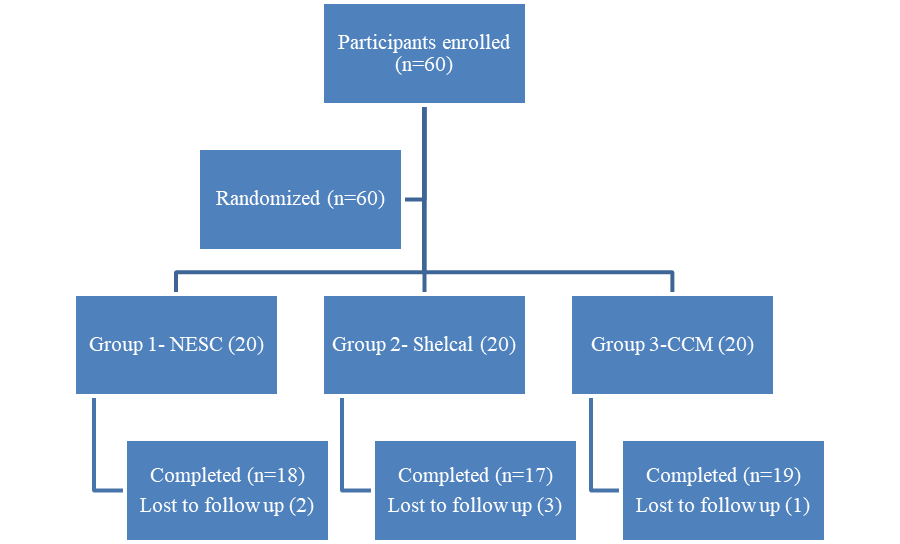
Table 1: Demographic details:
|
Gender |
Group |
Total |
||
|
CCM |
MICROCORE NESC® |
Shelcal |
||
|
Female |
13 |
11 |
12 |
36 |
|
68.40% |
61.10% |
70.60% |
66.70% |
|
|
Male |
6 |
7 |
5 |
18 |
|
31.60% |
38.90% |
29.40% |
33.30% |
|
|
Total |
19 |
18 |
17 |
54 |
|
Age |
50.82 (6.56) |
56.0 (3.98) |
54.41 (5.21) |
|
Table 2: Improvement in BMD (T score):
|
Group |
BMD (T score) |
N |
Mean |
Std. Deviation |
p-value |
|
MICROCORE NESC® |
Baseline |
18 |
-2.01 |
0.82193 |
0.001 |
|
Post study |
18 |
-1.1694 |
0.82156 |
||
|
Shelcal |
Baseline |
17 |
-2.4829 |
0.91187 |
0.002 |
|
Post study |
17 |
-1.8535 |
1.1767 |
||
|
CCM |
Baseline |
19 |
-1.9933 |
1.69828 |
0.82 |
|
Post study |
19 |
-1.8961 |
0.75263 |
There is a significant improvement in the BMD T scores- post treatment with MICROCORE NESC® and shelcal (on using paired t test). MICROCORE NESC® is showing a higher level of significance when compared to shelcal.
Figure 2: BMD (T score) levels
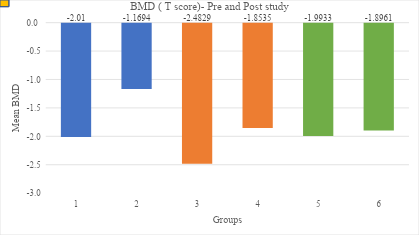
Table 3: Changes in the osteocalcin levels:
|
Group |
BMD |
N |
Mean |
Std. Deviation |
p-value |
|
MICROCORE NESC® |
Baseline |
18 |
11.5644 |
3.85392 |
0.374 |
|
Post study |
18 |
10.38 |
2.643 |
||
|
Shelcal |
Baseline |
17 |
9.3525 |
2.82222 |
0.95 |
|
Post study |
17 |
9.26 |
5.232 |
||
|
CCM |
Baseline |
19 |
10.0123 |
2.42534 |
0.269 |
|
Post study |
19 |
11.64 |
4.865 |
Reduction in osteocalcin (carboxylated) levels is a marker for reduced osteoporosis. Reduction in Serum osteocalcin levels is observed in MICROCORE NESC® and shelcal treated group (paired t test). But there is no statistically significant reduction in any of the treatment groups.
Table 4: Serum calcium levels for relative absorption and bioavailability:
|
Group |
Serum Calcium |
N |
Mean |
Std. Deviation |
p-value |
|---|---|---|---|---|---|
|
MICROCORE NESC® |
Predosing |
18 |
8.1 |
0.766 |
0.0001 |
|
30 minutes |
18 |
7.964 |
0.7323 |
||
|
60 minutes |
18 |
8.06416
|
0.55 |
||
|
90 minutes |
18 |
8.26 |
0.572 |
||
|
135 minutes |
18 |
8.37 |
0.755 |
||
|
180 minutes |
18 |
8.39 |
0.613 |
||
|
225 minutes |
18 |
8.757 |
0.7345 |
||
|
270 minutes |
18 |
9.129 |
0.7237 |
||
|
Shelcal |
Predosing |
17 |
8.83 |
0.74 |
0.012 |
|
30 minutes |
17 |
8.769 |
0.7087 |
||
|
60 minutes |
17 |
8.785 |
0.7819 |
||
|
90 minutes |
17 |
8.85 |
0.647 |
||
|
135 minutes |
17 |
9.01 |
0.596 |
||
|
180 minutes |
17 |
9.38 |
0.971 |
||
|
225 minutes |
17 |
9.377 |
1.2807 |
||
|
270 minutes |
17 |
9.715 |
1.3662 |
||
|
CCM |
Predosing |
19 |
8.65 |
1.076 |
0.003 |
|
30 minutes |
19 |
8.533 |
1.0299 |
||
|
60 minutes |
19 |
8.608 |
0.8458 |
||
|
90 minutes |
19 |
8.71 |
0.977 |
||
|
135 minutes |
19 |
8.87 |
0.804 |
||
|
180 minutes |
19 |
8.84 |
0.776 |
||
|
225 minutes |
19 |
9.133 |
0.9119 |
||
|
270 minutes |
19 |
9.3 |
0.9544 |
There is a significant improvement in the serum calcium levels from baseline up to 270 minutes in all the three groups on applying repeated measure ANOVA.
There is a higher percentage of improvement in calcium absorption as depicted by an increase in serum calcium levels (10.23%) in the MICROCORE NESC® treated group when compared to Shelcal (7.7%) and CCM (7.2%) – table 5 and figure 3.
Figure 3: Serum calcium levels- Graphical Representation
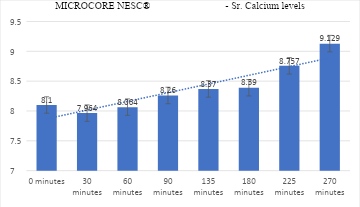
Table 5: Percentage improvement in Sr. calcium levels compared to Baseline (Bio availability):
|
Sl. NO. |
Time Point |
MICROCORE NESC® Sr. calcium (% improvement) |
SHELCAL Sr. calcium (% improvement) |
CCM Sr. calcium (% improvement) |
|
1 |
0 minutes |
8.1 (0) |
8.83 (0) |
8.65 (0) |
|
2 |
270 minutes |
9.1 (10.23%) |
9.71 (7.76%) |
9.3 (7.27) |
Table 6: Pharmacokinetic parameters:
|
Group |
Cmax (mg/dl) |
AUC last |
Tmax (Hours) |
|
MICROCORE NESC® |
9.341 |
38.1537 |
3.38 |
|
Shelcal |
9.753 |
40.7559 |
3.46 |
|
CCM |
9.183 |
38.9493 |
3.28 |
Relative Bioavailability = AUC(T) * Dose (R) * 100/ AUC (R)* Dose (T)
Relative bioavailability of MICROCORE NESC® with respect to Shelcal = 38.15*500*100/40.75*500 = 93%
Thus, the relative bio availability of MICROCORE NESC® with respect to shelcal was 93%
Table 7: Change from baseline to post study in knee / body pain intensity measured by pain VAS scale:
|
Group |
VAS Score |
N |
Mean |
Std. Deviation |
% Reduction |
p-value |
|
MICROCORE NESC® |
Baseline |
18 |
5 |
1.029 |
64.4 |
0.0001 |
|
Post study |
18 |
1.78 |
0.808 |
|||
|
Shelcal |
Baseline |
17 |
4.53 |
0.874 |
59.9 |
0.0001 |
|
Post study |
17 |
1.82 |
1.185 |
|||
|
CCM |
Baseline |
19 |
4.68 |
1.157 |
47.23 |
0.0001 |
|
Post study |
19 |
2.47 |
1.219 |
There is a statistically significant improvement in the VAS pain scores from baseline to post study in all the treatment groups.
Changes from base line to post study in quality of life- Feedback Questionnaires have shown that the general health status has improved to very good/ excellent in 83% of patients in MICROCORE NESC® treated group compared to 76 % in shelcal treated group and 61% in CCM group. The limitation of activities has shown an improvement of around 72 % in MICROCORE NESC® treated group compared to shelcal with 70 % and CCM with 57.9%.
The improvement in physical health problems has shown an improvement of around 94.4 % in MICROCORE NESC® treated group compared to shelcal with 88.2 % and CCM with 94.7%.
DISCUSSION:
Natural Egg Shell Calcium (MICROCORE NESC®) is a naturally rich source of calcium carbonate and has been studied as a treatment for management of symptoms related to osteoarthritis, osteopenia and osteoporosis.MICROCORE NESC® has shown to cause a reduction in the production of pro-inflammatory cytokines, such as interleukin-1beta and tumor necrosis factor-alpha.[14] MICROCORE NESC® has been shown to improve recovery from exercise-induced joint pain, decrease stiffness, and reduce discomfort immediately after exercise (stiffness) in post-menopausal women taking 500mg once daily for 2weeks.[13] Our study has also confirmed the same by showing a reduction in VAS pain scores and improvement in performance related quality of life questionnaires.
It has also been well documented that a positive correlation exists between cholecalciferol and total BMD improvement.MICROCORE NESC® has natural Strontium in it. Strontium has a dual effect of inhibiting bone resorption (Osteoclastic) and stimulating new bone formation(Osteoblastic) and its biological behavior as well as the metabolism and distribution of strontium mimics that of calcium.[12] Studies have shown that Strontium Supplements increases bone mass density and reduces the risk of vertebral and normal bone fracture.
A tight control of magnesium homeostasis seems to be crucial for bone health. On the basis of experimental and epidemiological studies, both low and high magnesium have harmful effects on the bones. Magnesium deficiency contributes to osteoporosis directly by acting on crystal formation and on bone cells and indirectly by impacting the secretion and the activity of parathyroid hormone and by promoting low grade inflammation.[17]
Oral intake of zinc supplements could help to protect bone from resorption in various conditions, such as aluminum toxicity, Ca deficiency, vitamin D deficiency, estrogen deficiency, diabetes, and arthritis. Zinc improves Bone Mineral Density.[18,19] Microcore NESC® Tablet consist of calcium carbonate natural source (Natural Egg Shell Calcium) 1250 mg equivalent to elemental calcium 500 mg, cholecalciferol ID- 600 IU, magnesium gluconate 100mg (Elemental magnesium at 16% which is 16 mg) and zinc citrate 42 mg (Elemental zinc at 31% which is 13.2 mg) and natural strontium.
This novel combination of ingredients has shown a better oral relative bio availability of calcium, better improvement of BMD while compared to other preparations like Shelcal and CCM. There is a significant improvement in the BMD (T score) post treatment with MICROCORE NESC® and Shelcal. MICROCORE NESC® is showing a higher significance when compared to Shelcal. The progression from osteopenia to Osteoporosis has been reduced, as serum carboxylated osteocalcin levels decreased from base line to post study values, in MICROCORE NESC® treatment group. Reduction in osteocalcin (carboxylated) levels is a marker for reduced osteoporosis. Reduction in Serum osteocalcin levels is observed in MICROCORE NESC® and shelcal treated group. However, there is no statistically significant reduction in any of the treatment groups. There is a higher percentage of improvement in calcium absorption as depicted by an increase in serum calcium levels (10.23%) in the MICROCORE NESC® treated group when compared to Shelcal (7.7%) and CCM (7.2%) at 270 minutes after administration. The relative bio availability of MICROCORE NESC® with respect to shelcal was 93%. For calcium, which is an endogenous substance, measurement of absolute bioavailability of an oral dose requires the use of isotopic methods, but for assessing relative oral bioavailability, the pharmacokinetic method is a convenient and acceptable tool. Hence, the same was applied here. The literature reference shows that absorption of calcium carbonate(shelcal) is 22% and that of CCM is 42% considering its elemental calcium of 40% and 24%, respectively.
There were no clinically significant lab abnormalities (pre and post study) in any of the treatment groups. There were no serious adverse events reported during the study period. All the participants tolerated the test products and the compliance was good. There is a significant reduction in Total cholesterol and LDL levels, post treatment with MICROCORE NESC® for a period of 12 weeks. Studies have shown that supplemental calcium alone or combined with vitamin D3 may reduce serum lipids and lipophilic micronutrients. The general health status has improved to very good/ excellent in 83% of patients in MICROCORE NESC® treated group compared to 76 % in shelcal treated group and 61% in CCM group.
Overall, the quality of life questionnaire has shown a better improvement in the general health, reduction in bodily pain, without any limitation of activities in all the three groups. There is also a better improvement in the emotional health, social activities and pain in MICROCORE NESC® and Shelcal treated group.
CONCLUSION:
This novel combination of ingredients of MICROCORE NESC®, has shown a better oral relative bio availability of calcium (93%), better improvement of BMD T score, over a treatment period of 12 weeks, while compared to other preparations like Shelcal and CCM. However, MICROCORE NESC® and Shelcal is showing a comparable performance in many other parameters, the absorption and side effect profile is better with MICROCORE NESC®. This study has also highlighted that MICROCORE NESC® treatment has shown to bring down osteocalcin levels, which is marker for reduction in osteoporosis. Thus, MICROCORE NESC® can be considered a better and safe calcium supplement, as there are very few side effects observed without any clinically significant abnormalities in lab parameters and Patient compliance to the test product was exceptionally good, throughout the study.
M. Chandra Mohan
Globally Recognized Biotechnology Entrepreneur, Patented Indian Scientist, and Business Leader
Founder & Chairman & Managing Director (CMD) of Microcore Research Laboratories India Pvt. Ltd. and Thiruppugazh Biotech Pvt. Ltd., M. Chandra Mohan is renowned for his pioneering contributions to biotechnology, innovation-driven research, and sustainable scientific advancements. His leadership has positioned both organizations at the forefront of biotechnology research, product development, and scientific excellence.
